
Architecture
OwlLayer lets an agent act within an existing interface only through the tools the application declares. The frontend exposes the useful context of the current screen and its active tools; OwlLayerServer maintains the session and talks to the configured LLM adapter.
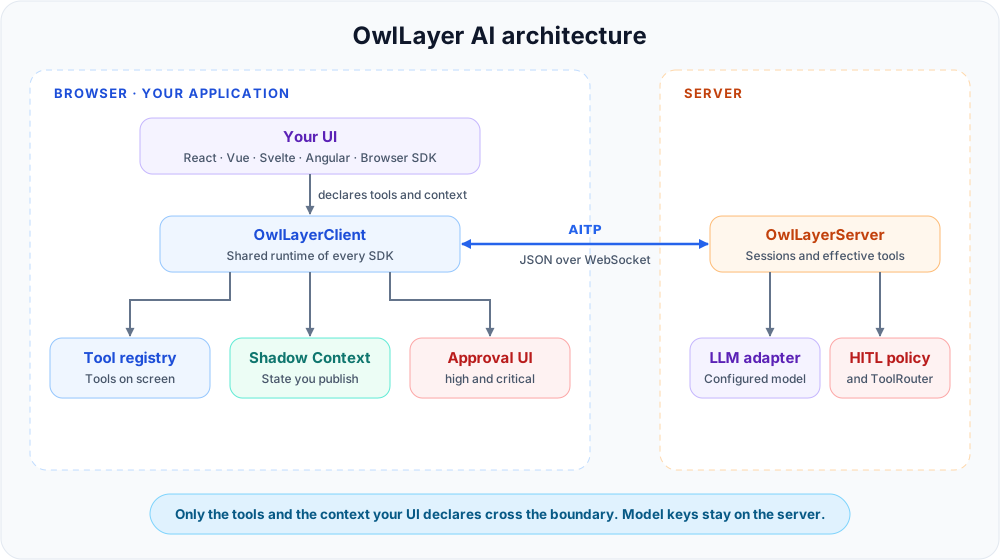
Main Flow: AITP
AITP (Agent-to-Interface Transfer Protocol) is the JSON message protocol transported over WebSocket between OwlLayerClient and OwlLayerServer. AITP carries application-authorized information, visible tools, and action requests, without giving the model free access to the DOM.
The cycle is:
- The framework SDK uses the
OwlLayerClientruntime from@owllayer/core. - The client synchronizes its context and active tools via
CONTEXT_UPDATE. OwlLayerServerstores this state in the relevant session and sends it to the LLM adapter when a user message arrives.- If the model requests a frontend tool, the server sends
TOOL_CALLto the same client and awaits itsTOOL_RESULT.
System Layers
| Layer | Main Package | Responsibility |
|---|---|---|
| Shared contracts | packages/core/ | AITP protocol, OwlLayerClient, tool registry, HITL, and voice states |
| Server | packages/server/ | Sessions, transport, routing, security, storage, and LLM orchestration |
| Model adapters | packages/adapter-google/, packages/adapter-openai/ | Connect OwlLayer to the selected model provider |
| UI SDKs | packages/react/, vue/, svelte/, angular/, browser/ | Expose OwlLayer primitives in developer applications |
| Demos | apps/demo* | Demo applications for each SDK |
| Documentation | apps/docs-site/ (Astro), docs-site/ (VitePress) | Published documentation |
Monorepo Structure
owllayer/
├─ apps/
│  ├─ demo/              # React demo
│  ├─ demo-vue/          # Vue demo
│  ├─ demo-svelte/       # Svelte demo
│  ├─ demo-browser/      # Browser SDK demo
│  ├─ demo-angular/      # Angular demo
│  ├─ demo-server/       # Demo server
│  └─ docs-site/         # Astro + Starlight docs
├─ packages/
│  ├─ core/              # Shared contracts & client runtime
│  ├─ server/            # Node.js server & transport
│  ├─ adapter-google/    # Gemini adapter
│  ├─ adapter-openai/    # OpenAI adapter
│  ├─ react/             # React SDK
│  ├─ vue/               # Vue SDK
│  ├─ svelte/            # Svelte SDK
│  ├─ angular/           # Angular SDK
│  ├─ browser/           # Vanilla JS / Preact SDK
│  └─ ui/                # Shared UI runtime & dashboard
├─ plugins/               # Official plugin packages
├─ docs-site/             # VitePress EN docs (this site)
└─ docs/                  # Historical Markdown sources
What Crosses the Layers
Interface context is not an authorization to act. Exposed data helps the model understand the situation; only declared tools define the actions it can request. The server then applies authentication, rate limiting, and HITL control before routing a call.
Data flow summary
┌─────────────────┐    AITP/WS    ┌─────────────────┐    LLM API    ┌───────────────┐
│   Browser App   │◄───────────►│ OwlLayer Server│◄───────────►│  LLM Provider │
│                 │              │                 │              │               │
│ • OwlLayerClient   │              │ • Sessions       │              │ • Gemini      │
│ • Tool Registry │              │ • Auth/Rate Limit│              │ • OpenAI      │
│ • Shadow Context│              │ • HITL Enforce   │              │ • Custom      │
│ • HITL UI       │              │ • Adapter Routing│              │               │
└─────────────────┘              └─────────────────┘              └───────────────┘
Adapters
OwlLayer uses an adapter pattern to connect to LLM providers. Each adapter translates OwlLayer session state (context + tools + history) into the provider's native API format.
Currently supported:
@owllayer/adapter-google: Gemini models (2.0 Flash, Pro, etc.)@owllayer/adapter-openai: OpenAI models (GPT-4o, etc.)
Custom adapters can be built by implementing the LLMAdapter interface from @owllayer/core.
Technical Notes
- The repository is a pnpm monorepo with Turborepo orchestration.
- Builds and tests run from the root.
- All packages share a common
tsconfig.base.json. - Tests use Vitest.
- CI uses GitHub Actions with Danger.js for PR checks.